Every island has a story that explains its relationship with the ocean. On Guam, that story is Sirena—a legend told quietly, persistently, and with purpose, as if repetition itself is a form of protection.
Sirena was a young Chamorro girl, obedient in public and restless in private, living in a village where the sea was both pantry and peril. Like many legends, her story begins with something ordinary: chores. Sirena was sent to fetch fresh water, a simple task made complicated by temptation. Along the way, she lingered at the shore, drawn by the water’s movement, its music, its promise of something beyond instructions and duty.
When her grandmother called for her, Sirena did not answer.
In Chamorro culture, elders’ words carry weight. They are not suggestions; they are anchors that hold families together. Sirena’s silence—whether born of distraction or defiance—was a rupture. Angry and afraid, her grandmother spoke words she could not take back, calling on the sea to claim Sirena if the ocean mattered more to her than home.
The transformation began immediately. Sirena’s legs fused, her body drawn toward the water she loved. But this is where the legend deepens, and where it becomes unmistakably Chamorro.
Sirena’s nina—her godmother—heard the commotion and rushed to the shore. In Chamorro culture, a godparent is not symbolic; they are family, bound by responsibility and spiritual authority. Seeing Sirena being claimed by the sea, the nina intervened, calling out that Sirena was not solely her grandmother’s to give away. She was also hers. If the sea was to take a part of Sirena, then the nina’s portion must remain human.
The ocean, again, listened.
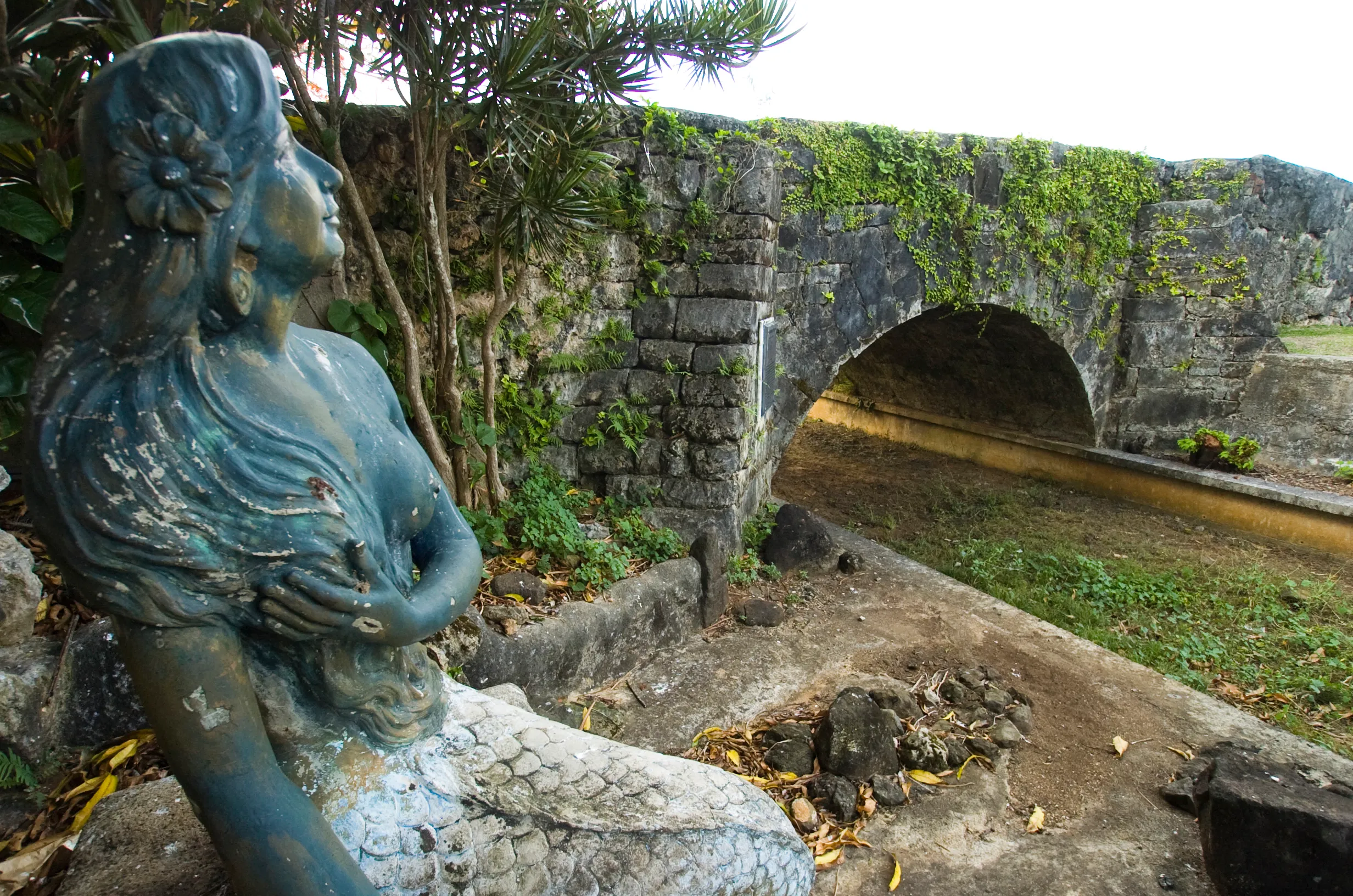
The transformation stopped halfway. Sirena emerged from the water changed—her upper body human, her lower body a fish’s tail. She was no longer fully of the land, nor entirely of the sea. She looked back once, raised her hand in farewell, and disappeared beneath the waves.
The grandmother wept. The nina could only watch. What was spoken in anger had been reshaped by love, but not undone.
Sirena’s legend endures because it carries layered lessons. Words have power beyond intention. Family extends beyond blood. Godparents are not witnesses; they are guardians. And the ocean, though beautiful and generous, answers only on its own terms.
Today, Sirena is remembered as Guam’s mermaid, appearing in stories, art, and memory. Some say she watches over swimmers. Others say she sings beneath the waves, her voice carried by currents only the island understands. She is not simply a warning to children or a tale of punishment. She is a reminder that love can intervene—but even love cannot always restore what has been given away.
Sirena did not become a mermaid because she disobeyed. She became one because the sea was called, family spoke, and the island listened.
Editor’s Note
Like many oral traditions, the legend of Sirena exists in multiple forms, passed down through families, villages, and generations. Details may differ—who intervenes, how the transformation unfolds, and what lessons are emphasized—but the heart of the story remains the same. The version presented here is one telling among many, shared with respect for Guam’s rich storytelling tradition and with the understanding that no single version can fully contain a legend that lives through its people.
 play_arrow
 play_arrow
 play_arrow




Vern on January 25, 2026
Thanks for sharing